Oceans Rise and Then Fall Again Oceans Rise and Then Fall Again Lyrics
How long has Earth's atmosphere included oxygen? A contempo paper suggests low levels of oxygen appeared in the temper approximately ii.95 billion years ago. That's most 550 million years earlier than previously idea.
Agreement the origin of atmospheric oxygen is central to study of the evolution of life.
The birth of oxygen
Early biospheres consisted of extremophile leaner living in high-temperature, depression oxygen and low-pH (acid) environments, such as volcanic vents in the deep ocean.
COii and H2 reacted with ane some other to produce organic molecules and methane. Organic matter was produced where carbon dioxide, h2o and solar light energy combine to course carbohydrates and oxygen. Cyanobacteria released oxygen near the surface of the sea.
The oldest known examples are the microbial colonies known as stromatolites, which grew upwards in shallow water toward the sunday around 3.43 billion years agone, as constitute in the Pilbara region of Western Australia (run into the image beneath).
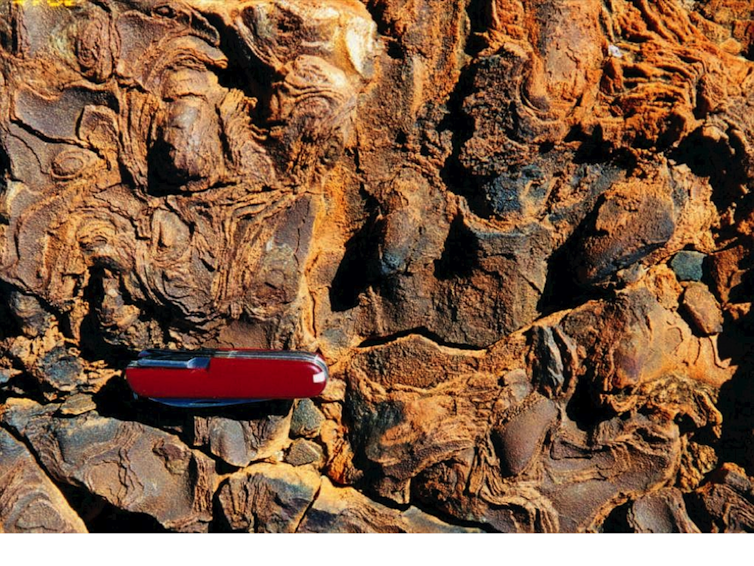
Oxygen levels during Earth's first ii billion years are estimated every bit x−5 times present levels. According to researchers Kasting and Donahue, at that phase free oxygen would probably had a toxic effect on primitive life forms.
Oxygen's evolution
Pioneering studies by Heinrich Holland suggest several stages in development of oxygen.
Around 3.85 billion years ago, the temper was largely or entirely devoid of oxygen. So were the oceans, with the possible exception of oxygen oases in the shallow oceans.
Around ii.45 million years ago, atmospheric oxygen levels rose sharply, levelling out around 1.85 million years ago. The shallow oceans became mildly oxygenated, while the deep oceans connected to be anoxic.
About 635 meg years ago the rise of Ediacara fauna, found in the Flinders Ranges in South Australia, signifies a global rise in atmospheric oxygen level. This is because the protein molecule of multicellular organisms requires oxygen for its synthesis.
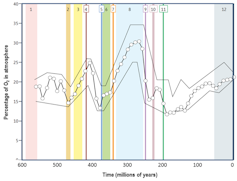
Atmospheric oxygen levels rose significantly from about 0.54 1000000 years ago, reached a peak in the Permian near 300 – 250 one thousand thousand years ago, then dropped to the Jurassic from almost 200 million years agone, following which they rose slowly to present levels, shown in the graph left.
Some authors advise the rise in oxygen about 2,470 – 2,450 million years agone was related to extensive volcanic activity, a alter in the reduction-oxidation country of the volcanic gases, glaciation and deposition of banded iron formations.
Kump and Kasting advise variations) in the oxygen level of the Globe mantle and its magmatic products had an effect on the limerick of the ocean and atmosphere.
How practise we know when oxygen formed?
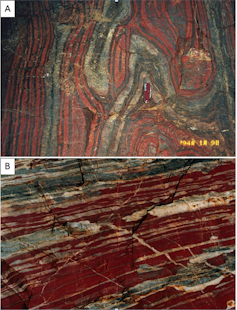
The abundance of banded iron formations and iron-rich jaspillite (come across image on the right) in early sediments can tell usa a lot well-nigh oxygen levels.
Some researchers believe that, under the depression-oxygen conditions of the Archaean atmosphere, iron dissolved in the body of water water as ferrous oxide (FeO), then was precipitated as ferric oxide (Fe2O3) through the oxidising action of bacteria and/or by photolysis, which is where sunlight photons trigger the chemical dissociation of water.
In some instances the increase in ferrous oxide concentration of the early on oceans followed major asteroid impacts, with likely erosion During these stages breakdown of iron-bearing minerals in the basalts and enhanced supply of FeO to the oceans were followed by oxidation and precipitation of banded iron formations.
The presence of unoxidised sulphide (metal-sulphur minerals) and uraninite (UO2) grains in sediments is taken as bear witness for low levels or absenteeism of oxygen. Studies of sulphur isotope relations permit researchers to brand inferences about whether there was an ozone layer in the early temper.
According to Kopp et al, nearly 2.3-ii.2 meg years ago oxygen - produced by cyanobacteria - could have destroyed a methane-rich greenhouse atmosphere and triggered a glacial consequence on timescales equally brusque as one million years. This suggests oxygenic cyanobacteria evolved and radiated before long before that time.
It has been suggested the primeval cyanobacteria evolved effectually 2.7 million years agone and that transient atmospheric oxygenation occurred as far back as 2.7-2.6 one thousand thousand years ago. Nevertheless, the recent newspaper by Crowe et al suggests an even earlier rise of oxygen.
This inference is based on oxidation weathering detected by the researchers when they looked at the 2.95-billion-twelvemonth-quondam palaeo-soils and banded iron formations of the Pongola Supergroup, in Southward Africa. The researchers noted the distribution of chromium isotopes and redox-sensitive metals in these soils. Chromium isotopes are sensitive to reactions involving oxygen, with the heavier isotope being slightly more soluble when oxidised than the lighter one.
Based on these researchers' calculations, atmospheric oxygen concentrations at that phase were 3 × 10⁻⁴ times the present levels. The extra oxygen was in function converted in the atmosphere into ozone (Oiii), which filters dissentious solar ultraviolet radiation, assuasive new microbial species to emerge.
Oxygen and life
When late Proterozoic oceans became enriched with oxygen, it allowed protein chains to develop. This meant Ediacara fauna – the earliest known multicellular organisms – could sally in the oxygenated oceans.
Canfield et al suggested oxygen levels were the critical cistron allowing multicellular animals to emerge. A prolonged stable oxygenated environment may have permitted bilateral mobile animals to sally afterwards glacial termination almost 635 meg years ago
This was followed by the [onset of the Cambrian explosion](http://en.wikipedia.org/wiki/Wonderful_Life_(book%29) of life, when a rich diversity of organisms developed.
There were high levels of oxygen during the late Carboniferous-Permian and Cainozoic ice ages. These levels are thought to relate at least in role to the strong growth of mid and depression-latitude forests, which released oxygen through photosynthesis.
Conversely, warmer periods such as the early Cretaceous and Jurassic and early Devonian are characterised past oxygen levels below ~fifteen%. This is likely because of all-encompassing burning of terrestrial vegetation.
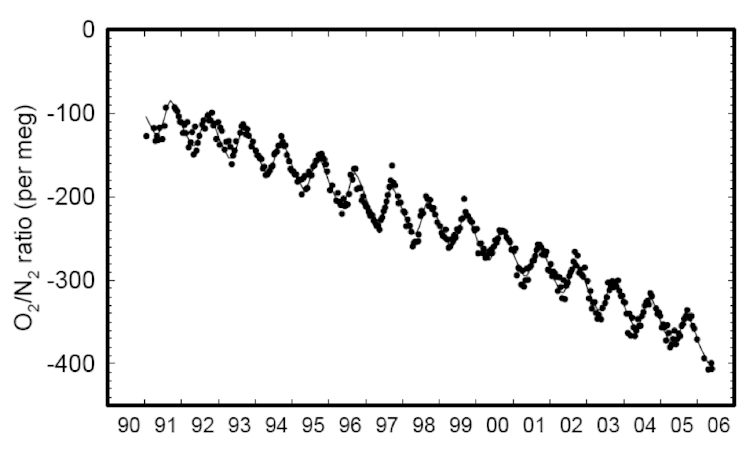
Electric current climate alter constitutes a major oxidation issue. More 560 billion tons of carbon have to engagement been released from geological deposits and from land immigration. This carbon is oxidised by interaction with atmospheric oxygen, lowering its level by a small amount (see paradigm above).
A farther pass up in the atmospheric level of oxygen would exist reversed by ensuing tropical conditions nether higher temperatures, evaporation and rainfall in some parts of the world, whereas in other regions evolution of draughts would result in further burning and oxidation, the final rest of oxygen remaining unknown.
Source: https://theconversation.com/the-rise-and-fall-of-oxygen-18954
0 Response to "Oceans Rise and Then Fall Again Oceans Rise and Then Fall Again Lyrics"
Post a Comment