Drupal 8 Uploading and Linking to File
The File module enables y'all to upload and attach files to content and to manage these uploads if you accept the appropriate permissions. This module is responsible for validating file content and managing uploaded files. It also provides options for displaying file content.
Every bit a site administrator, you will be able to command what type of files can be uploaded and their maximum size.
The File module provides its functionality by defining a File field type for the Field module. File attachments are divers at the content type level (or other entities). To learn how to define a field and add together it to a content type, encounter Working with Field UI.
Uses
Calculation a file field to a content type
Navigate to the "Manage fields" tab of the content type to which you wish to add the file field ( Administer > Structure > Content types , and the link manage fields for your specific content type).
Select the field type file, give the field a label and machine name, click-and-drag it to the place you want to have information technology among your fields, and hit the relieve button.
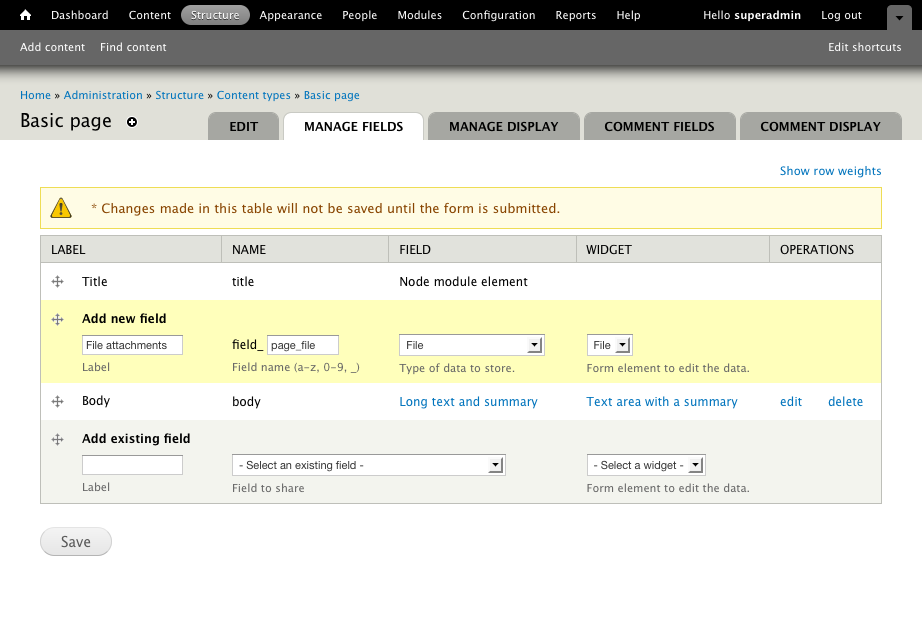
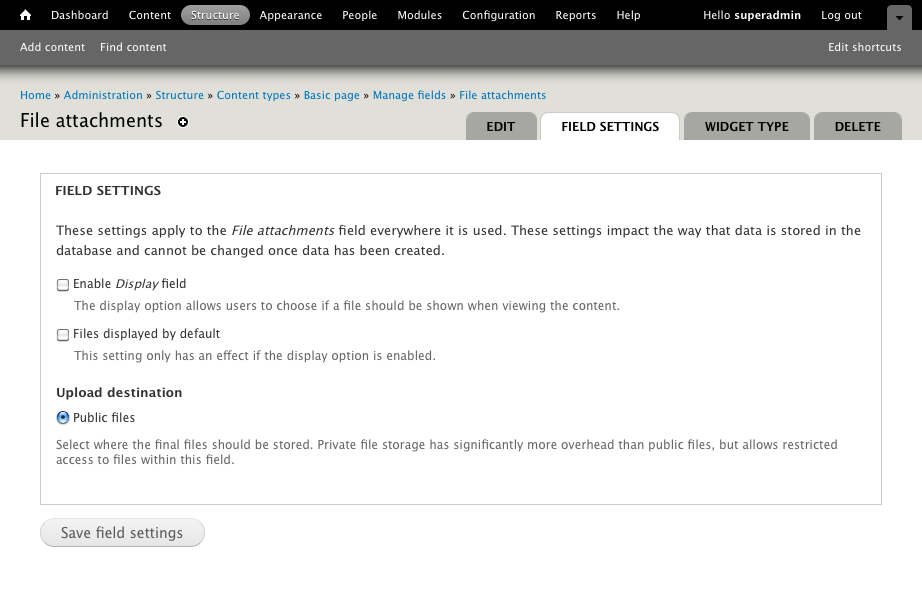
Equally when calculation whatsoever new field, you are first required to set the field specific settings. These apply for all places where you use the field. These cannot exist changed per entity.
- When checked, the Enable Display field option allows users to choose if a file should be shown when viewing the content.
- The Files displayed by default option makes the display file option checked past default, when users upload files to this field.
- The Upload destination by default only has the public files option bachelor – making the files bachelor right from the server (without Drupal checking any access). If you want to employ private files, you must showtime change some settings at the file system administration page (Administer > Configuration > Media: File organization). See below for details.
The adjacent step is to set the field settings for this instance only. This can exist changed between different content types (or other entities).
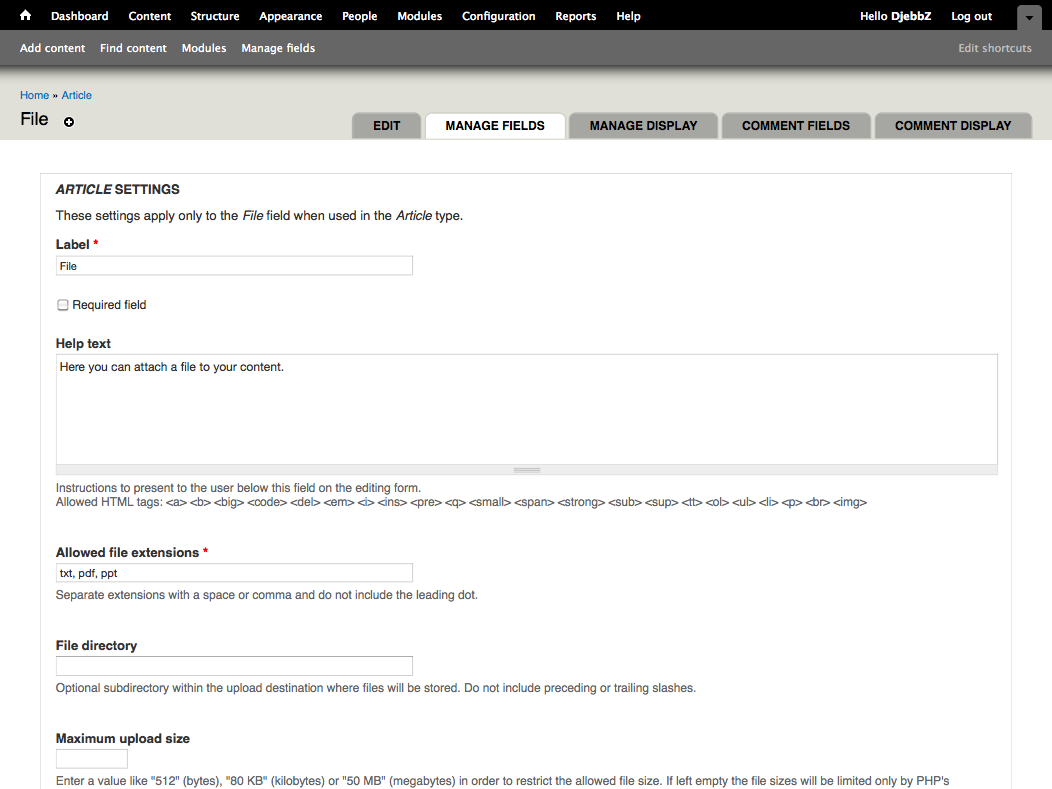
You lot can add validation options for the File field when you configure the content type. You lot must list all of the file extensions that the final user will need to be able to upload. The optional file directory where the files volition exist uploaded is a sub-directory of the file system path divers in the file system administration page (Administer > Configuration > Media: File system). You may specify a maximum file size for each file uploaded.
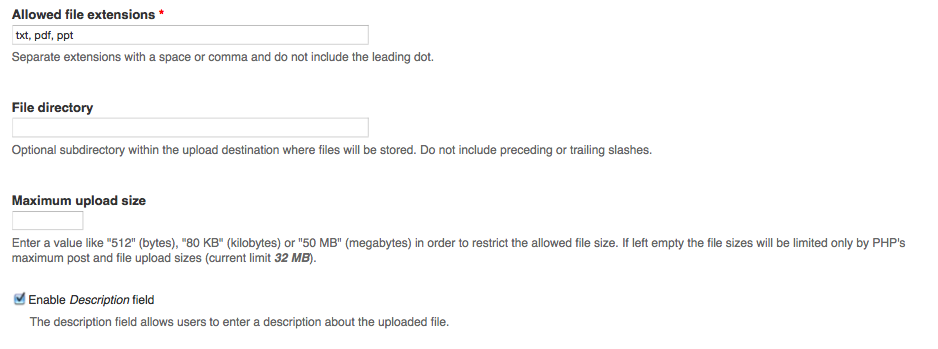
Managing attachment brandish
In one case a file has been fastened to content, you lot can specify whether it volition be displayed in the list of attached files or not. Listed files are displayed automatically in a section at the lesser of the content; non-listed files tin for example be embedded in your content, merely are non included in the list. (Embedding a file in your content means you re-create the path of the file and manually embed it where you want, for case, to insert in the content every bit a link tag. Note that the text format "Filtered HTML" past default refuses any paradigm tags..)

Additional options for managing the display of the file list are available in the "Manage brandish" tab of the specific content type'due south assistants page (Administer > Structure > Content types and the link field brandish for your content type).
Managing file locations and access
When you create a file field, yous tin specify the sub-directory of the site'southward file organisation where uploaded files for this content type volition be stored. The site's file arrangement paths are divers on the File system page (Administrate > Configuration > Media: File system).
You tin also specify whether files are stored in a public directory or in a private file storage surface area. Files in the public directory tin be accessed direct through the web server; when public files are listed, direct links to the files are used and anyone who knows a file's URL can download the file. Files in the private directory are not accessible directly through the web server; when private files are listed, the links are Drupal path requests (for example, "/system/files/proper noun-of-the-file.pdf"; here, "system/files/" is not an actual binder in the filesystem whose contents are served by the spider web server, just instead is a virtual URL managed by Drupal through which the private files can be downloaded). This adds to server load and download time, since Drupal must resolve the path for each file download request, merely allows for access restrictions to be added.
The best practice for public files is to shop them in the multi-site directory like:
sites/default/files The default style to securely add a private directory for your files is to utilize a directory that can not be accessed directly past your web server, simply can be accessed by Drupal. Ideally this directory should be located outside of your Drupal root folder.
The uncomplicated style to add a private directory for your files is to create a sub-directory nether the public directory like:
sites/default/files/private When you specify the individual directory in admin/config/media/file-arrangement it will automatically create the sub-directory & create a simple .htaccess file with Deny from all. This stops Apache from serving files from this directory. Make sure that you test this past calculation a file to that directory and verifying that y'all can't scan there directly. If this isn't working, all files in this directory will be attainable to anyone who can guess the URL! Note that not-Apache web servers may demand boosted configuration to secure private file directories.
Whenever possible it'southward recommended that yous choose a directory located exterior of your Drupal root folder (or actually outside your spider web root), which may be tricky if you are on a shared host. If yous practise have access though, you can choose a private directory which volition be on the aforementioned level as your web root directory (often called public_html or www or similar) using:
../private Accessing Private Files
It is important to empathise that merely considering a file field is configured to utilise the private file system, that does not mean Drupal will prevent anyone from viewing files uploaded via that field. The files volition be served by Drupal (via a URL like "/system/files/proper name-of-the-file.pdf"), but Drupal volition only block users' access to download the file via that URL if there is a specific reason to do then.
For example: you take created a new content type with a file field which stores files in your site's private file directory. Side by side you create a node from this new content blazon and adhere 2 new files. When the node is published links to both fastened files are visible and anyone who can view the node may download the files. Now, if you unpublish the node so that your site's stop users tin can no longer access it, all attached files become inaccessible for download by those users besides, fifty-fifty if they employ the direct link to the files that worked when the node was published.
For effectively grained command of who can see/download attached files you will demand an additional access control module. Yous may write a module yourself, or use a contributed module such as Content Access.
Individual file system settings in Drupal viii
In Drupal 8, y'all tin no longer set individual file system via UI. Yous set it in your settings.php file. Search for this line in your settings.php:
# $settings['file_private_path'] = ''; add together the url path to your individual directory. It must be outside of your web root directory and be an accented path, for example /var/www/html/example.org/individual with web root in/var/www/html/example.org/web or /home/username/example.org/individual with spider web root in /home/username/example.org/web. Then it should look like:
$settings['file_private_path'] = $app_root . '/../individual'; Technical Details
PHP configuration
For file uploads to work, PHP must be configured properly. The post-obit PHP configuration variables may need to be ready or configured, in your PHP php.ini file, .htaccess file, or settings.php files.
-
file_uploads = Onmust be set to "On" -
upload_max_filesize = 24Mtin can't be larger thanpost_max_size -
max_input_time = 300small values may cause timeouts for large file uploads -
memory_limit = 64Msmall values may cause out of memory errors for big file uploads -
max_execution_time = 180pocket-sized values may cause timeouts for large file uploads -
post_max_size = 24Mlimits the size of input submitted to the website (including fastened files)
Top Tip: Make sure you're editing the correct php.ini file past going to YOURSITE/admin/reports/condition/php. This will display information about your current PHP setup which is existence used for Drupal (in essence it'south running phpinfo()). Now look for the 'Loaded Configuration File' section, this will listing the php.ini file you need to edit.
Clearing the Enshroud
Information technology is recommended you articulate the cache after making these updates. If you lot don't, and then Drupal is likely to mutter that the private files area is not protected.
Further Reference
- Securing file permissions and buying
Source: https://www.drupal.org/docs/8/core/modules/file/overview
0 Response to "Drupal 8 Uploading and Linking to File"
Post a Comment